Saturday, April 27, 2013

Our ancient Aboriginal narrative - who was first? and from where?


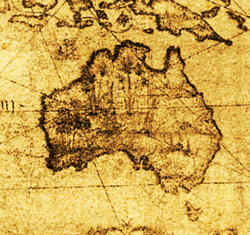
The First Race: Out-of-Australia, Not Africa!

By STEVE STRONG

Over the last decade, all manner of unexpected archaeological discoveries have led to many experts questioning much of what was assumed to be fact. Recent findings and field-work relating to little ‘hobbits’ in Flores Island, Siberian hominids with mtDNA connections to people of Papua New Guinea, the exclusivity of our distinct genetic Homo sapiens code being compromised by a 4% Neanderthal input, and a variety of unexpected findings have called into question many elemental assumptions held about the past.

... The dingo, accepted to have been brought into Australia from somewhere in Asia about 6,000 years ago, only strengthens the possibility of an extended Australo-Indian link. It would appear that the Dravidians adopted the Australian boomerang to hunt with, chose their better designed canoes to assist in fishing, and as is often the case when two cultures first meet, shared technology, friendship and genes.
There is so much more to this ancient Aboriginal narrative. At best we have provided a brief geographical overview of where ancient Aboriginal people sailed, and hopefully presented evidence validating their belief that they are descendents of the “First Race.”46 
Whether the African strand of Homo sapiens emerged 40,000 years ago is of no account, our focus is on the much earlier Australian genes, journeys and heritage. We have examined a few of the locations reached, but as for the religious legacy of the Dreaming as evidenced through the nine shared mystical principles, underpinned by equality of gender and species, that is yet another chapter of an ancient story that spans eons and geography. Their intimate awareness of the divine, along with the lesser gifts of sailing, astronomy, brain surgery, penicillin, burial/cremation/embalming, amputations, axe-making, democracy, bows and arrows, and so much more, is part of a forgotten origin that deserves to be heard once more.
Reposted from
http://www.newdawnmagazine.com/articles/the-first-race-out-of-australia-not-africa


Sunday, February 17, 2013

Mining and toxic waste - public left to finance restoration after mine closure

The Dee River in Queensland is being killed by toxic water from an old gold mine. Mount Morgan is one of thousands of abandoned and unregulated mine sites, many of which are leaking contaminated ‘legacy water’ into river catchments. Ian Townsend investigates.

Dee River at Dululu
Image: The Dee River at Dululu, 55km downstream from the Mount Morgan mine. The blue colour comes from dissolved copper. (Ian Townsend)
Well researched Background Briefing by ABC reporter Ian Townsend - listen to it at following link.

http://www.abc.net.au/radionational/programs/backgroundbriefing/2013-02-17/4513916

Thursday, February 14, 2013

Adverse health effects of Australia’s current minerals and energy policy


A new collaborative network of health organisations has agreed to joint action to raise awareness of the adverse health effects of Australia’s current minerals and energy policy at a meeting in Canberra this week.
Hosted by five national health organisations, the Public Health Association of Australia (PHAA), Climate and Health Alliance (CAHA), National Rural Health Alliance (NRHA), Climate Change Health Research Network (NCCARF-ARN), Australian Healthcare and Hospitals Association (AHHA), the Health and Energy Roundtable was attended by energy experts, community activists and health professionals, including doctors, physicians, nurses, physiotherapists and GPs, from dozen of organisations around the country.
A statement from the groups at the meeting, including the lead groups and joined by Cancer Council Australia, Heart Foundation, Australian Research Alliance for Children and Youth (ARACY), National Toxics Network (NTN), Australian Physiotherapy Association (APA), and New South Wales Nurses and Midwives Association (NSWNMA), signalled an intention to work together collaboratively to highlight the adverse health impacts and environmental damages associated with current minerals energy policy, particularly those relating to coal and coal seam gas.
"The risks to human health from energy and resources policy are not being well accounted for in current policy decisions," the joint statement said. ....The groups also announced an intention to develop a joint position statement on the health effects of Australia’s minerals and energy policies to inform public discussion about balancing the benefits and harms of our mineral and energy choices, specifically issues such as unconventional gas, coal exports and renewable energy.
For further information, contact Fiona Armstrong, CAHA Convenor convenor@caha.org.au or 0438900005.
Read original article at following link.

http://ahha.asn.au/news/health-groups-call-urgent-action-address-health-risks-coal-and-coal-seam-gas

Tuesday, February 12, 2013

Thursday, February 7, 2013

Public Transport: draft report for discussion


Walking, Riding and Access to Public Transport: draft report for discussion - until 31 January 2013

Closed now but comment anyway if you want.

In Logan city particularly, the State government's continued push ahead with high density development in multiple areas across the city is happening without provision of services for residents.
This unfortunately has led to a very large part of the budget over $180 million being allocated to roads. The new areas have no public transport, no safe cycling provisions and no few support services.
Poor planning from both sides of politics.

In addition no roads in Logan - local state or federally funded have 
FAUNA INFRASTRUCTURE 
ie safe places for wildlife to cross roads 

Roads only provide for some of our population. If you do not drive - for whatever reason, you are dependent on other services or people

Consider the aged who no longer drive but are able to move around interdependently. 
Consider  the young who are too young to drive but cycle and run. 
Consider the disabled - through birth or accident [that can be you later today]. 
Consider those who cannot afford the expenses of owning a car, some of whom drive unregistered and uninsured vehicles.
Consider the single carer / parent who has committed to caring for dependent folk whatever the age or ability.
In October 2012 the Australian Government released "Walking, Riding and Access to Public Transport: draft report for discussion". The draft report explores how the Australian Government can work with other governments, business and the community to encourage and support walking and riding as part of the transport systems in Australia's cities and towns. The Department of Infrastructure and Transport is seeking feedback on the report which will guide the Department's policy development process. Submissions are open until 5pm, 31 January 2013.
Report can be downloaded here  6 questions are posed for your ideas.